














 Facebook
 Twitter
 Pocket
 Reddit
 Email
Email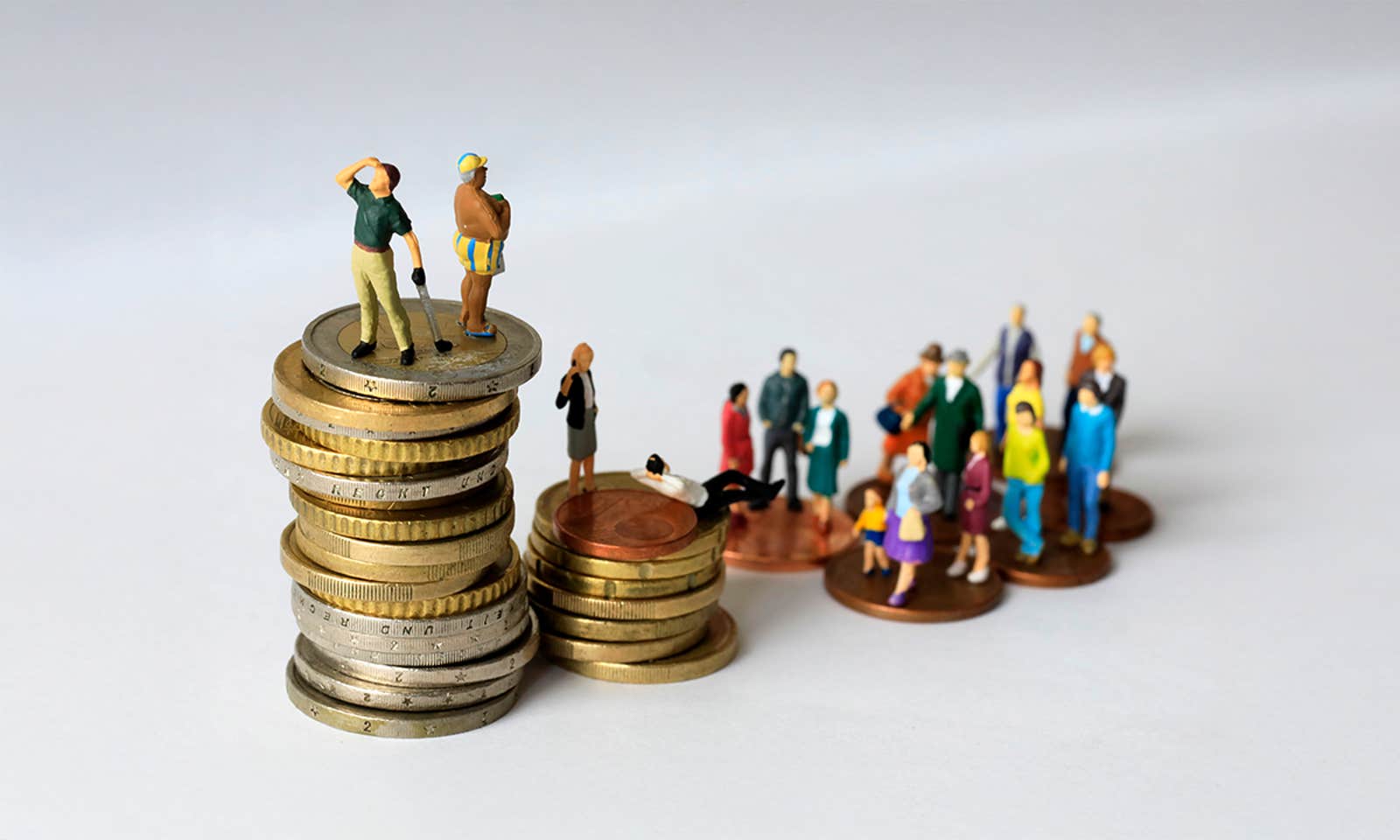

The gap between the haves and have-nots has grown even wider in recent decades in many wealthier nations. At the same time, however, researchers have observed that most people are against inequality in theory, but they disagree on how it should be solved. People’s opinion on this subject appears to vary, in part, based on how—and whether—they observe inequality around them.
These perceptions seem to be skewed by an individual’s social circle, which is often composed of people with similar incomes and levels of wealth. These homogenous niches can lead many of us to underestimate broader income inequality. This bias in our personal samples can sway sentiments toward taxes and other policies that spread the wealth around.
Now, a new study, in the journal PNAS Nexus, suggests that when lower-income people see lots of richer people in their milieu, they’re more in favor of wealth redistribution than when their environs seem fuller of people in a similar economic bracket. The finding, based on an online interactive group activity, suggests that this also comes with rising risks of conflict.
Researchers from the Santa Fe Institute and the London School of Economics created a model that simulates how people observe inequality in various social network structures and vote on taxes to redistribute money. Then, they tested the model’s predictions with an online experiment where 1,440 study participants based in the United States voted on tax rates.
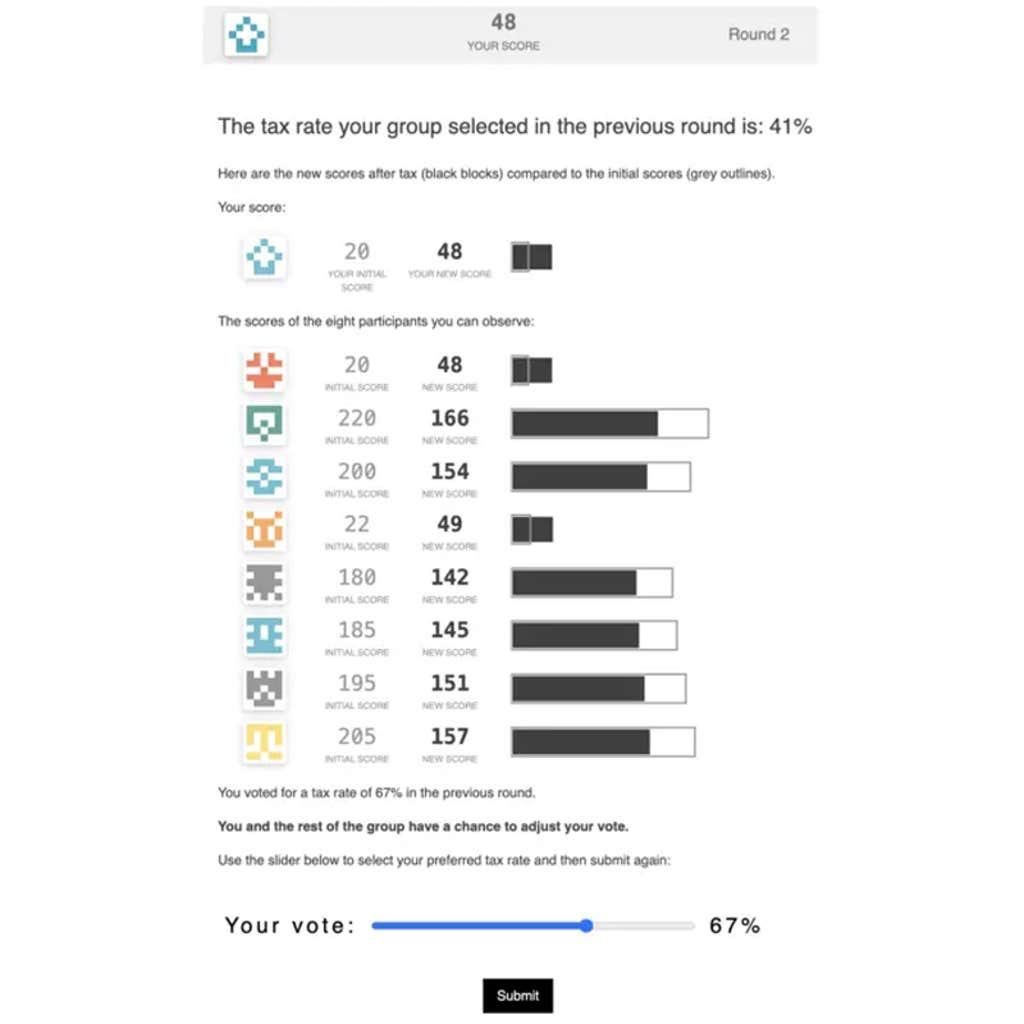
Participants were randomly assigned as “poor” or “rich” with corresponding numerical scores, and they could only see eight people at once on their screen, representing their hypothetical social network. The study subjects were told ahead of time that they’d potentially see a wide variety of scores. In these mini societies, the participants voted for a tax rate. Ultimately, the median vote won and the theoretical tax would be equally allotted among all the users. People were able to view their group’s vote results and change their vote over three rounds. Then they filled out a survey asking about individual demographics, voting motivations, and their opinions on the results.
These imagined worlds included a range of scenarios with varying rates of wealth diversity. Ultimately, segregated networks in which people only saw others with similar incomes resulted in the lowest wealth redistribution from taxes, even so the “poor” and “rich” were comparably satisfied and found it fair, and the votes were the least polarized. Meanwhile, when poorer participants viewed lots of rich participants, taxes spread more money among people—yet people reported less satisfaction, and their votes were more polarized. Throughout the various network scenarios, “richer” subjects infrequently upped their support for redistribution. But over more rounds, support among the poor grew as they watched the positive impacts of higher tax rates.
Read more: “Investing Is More Luck Than Talent”
These results differed from the model, which predicted that the network with majority rich participants would reduce vote polarization. That’s because the rich didn’t up their support for redistribution in any scenario, “while the poor radicalized to demand 100 percent taxation.” The authors ultimately identified a “a tradeoff between the level of redistribution and agreement about it, with no simple resolution,” they acknowledged in the paper.
“What we found was that wealth segregation is inequality’s best friend—it keeps the status quo by keeping the poor apathetic,” study author Milena Tsvetkova, a computational social scientist at the London School of Economics, wrote for The Conversation, “In contrast, observing the rich increases support for redistribution and reduces inequality.”
Going forward, the researchers suggest raising awareness of extreme wealth through social media, news reports, and political discourse. While this might worsen growing social friction, Tsvetkova noted that “dissatisfaction and polarization might be necessary for social change in a highly unequal society.” 
Enjoying Nautilus? Subscribe to our free newsletter.
Lead image: corlaffra / Shutterstock