















 Facebook
 Twitter
 Pocket
 Reddit
 Email
Email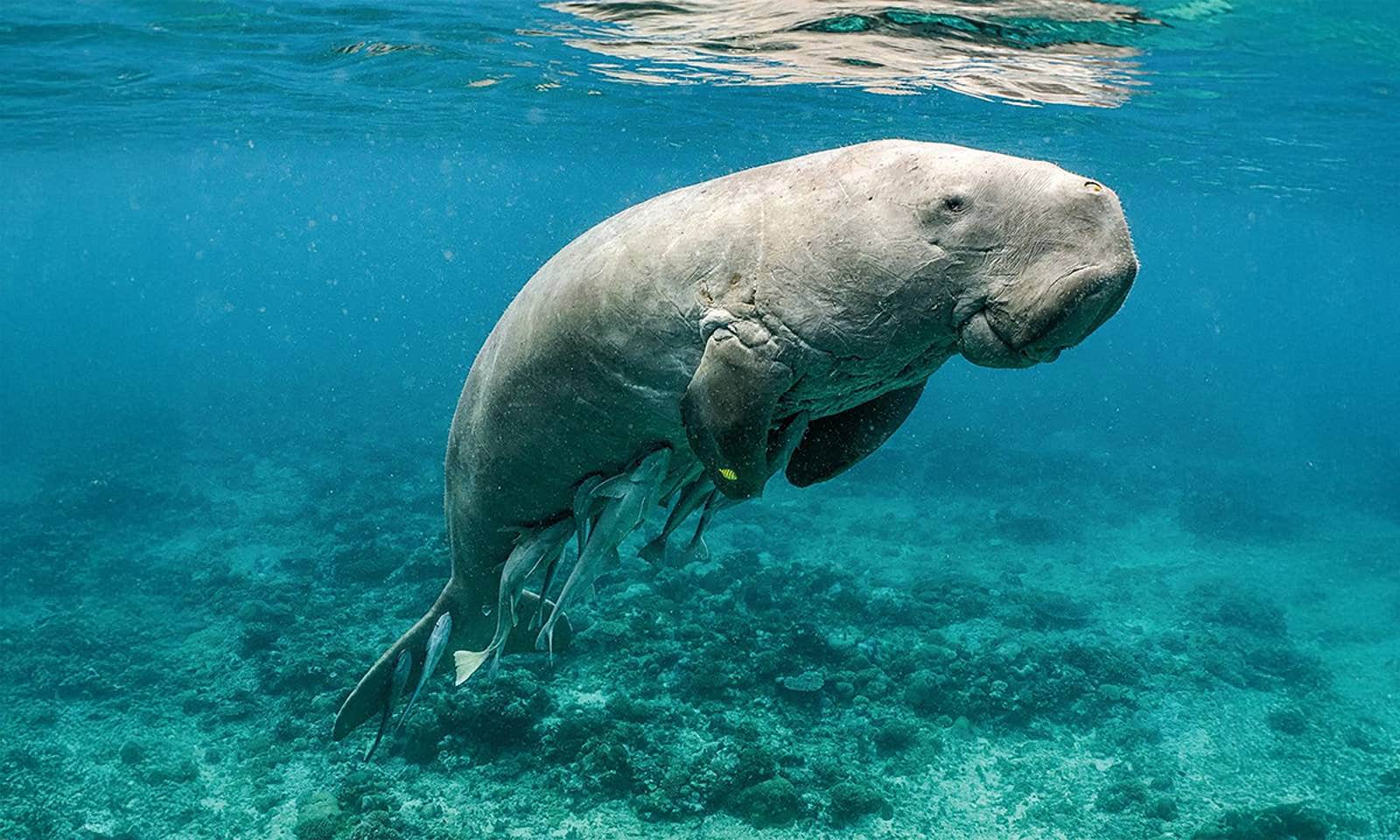


The sands of Qatar have yielded a secret 21 million years in the keeping. The peninsular, desert country that juts into the Persian Gulf was once the site of a thriving marine ecosystem when the area was covered by the waters of a more expansive Arabian Gulf.
Research findings published today in PeerJ reveal that this ancient ecosystem was shaped by a new species of sea cow, whose extant relatives continue such ecological engineering from the Americas to Australasia.
Paleontologists from the Smithsonian Institution and Qatar Museums explored a fossil bed in Qatar called Al Maszhabiya that was locally known as a “dugong cemetery.” In surveying that bone bed and other fossil deposits in southwestern Qatar using aerial photography and 3-D digitization, they found the remains of sharks, prehistoric dolphins, sea turtles, and sea cows. The bonebed yielded the richest assemblage of sea cow fossils known, with 304 bones across 172 distinct locations.
Read more: “The Hidden Fruits of the Deep”
Sea cows belong to the Order Sirenia and include manatees and dugongs. They are the only marine mammals that aren’t exclusively carnivorous. In contrast to seals, sea lions, and whales, the diets of sea cows are overwhelmingly vegetarian, which makes sense when you consider that their closest relatives are elephants. While elephants shape terrestrial habitats, a prodigious appetite for seagrasses makes both manatees and dugongs influential in engineering their aquatic ecosystems.
While the sea cow fossils unearthed by the scientists in Qatar looked like the bones of modern dugongs, which inhabit the Arabian Gulf, differences marked them as a species new to science. These Early Miocene sea cows had hind limbs, which are absent in modern dugongs and manatees, as well as a straighter snout and smaller tusks than their living relatives. The researchers dubbed this new species Salwasiren qatarensis. The study authors suggested that the new species, even with its distinct characteristics, played a similar ecological role to its living evolutionary relatives.
“This part of the world has been prime sea cow habitat for the past 21 million years—it’s just that the sea cow role has been occupied by different species over time,” said Smithsonian paleontologist and study co-author Nick Pyenson in a statement.
Seagrasses rarely fossilize, but the body morphology of the ancient dugongs revealed their ecosystem engineering potential. At an estimated 250 pounds, they were small for sea cows. Still, considering that sea cows must consume at least 10 percent of their body weight per day, just one S. qatarensis would have had to eat 25 pounds of aquatic vegetation daily. While the number of individual sea cows represented by the fossils at Al Maszhabiya is difficult to pin down, the S. qatarensis bones accounted for 98 percent of the documented vertebrate fossils the team catalogued, suggesting an outsized role in these ancient ecosystems.
“The density of the Al Maszhabiya bonebed gives us a big clue that Salwasiren played the role of a seagrass ecosystem engineer in the Early Miocene, the way that dugongs do today,” added Pyenson. “There’s been a full replacement of the evolutionary actors but not their ecological roles.”
Today, as dugongs in the Arabian Gulf probe the seafloor and voraciously feed, they leave trails through seagrass meadows that stir up nutrients as well as ultimately promote seagrass diversity. But, with decreasing populations threatened by coastal development, incidental capture in fishing gear, boat strikes, and declines in seagrasses, dugongs face an uncertain future.
“If we can learn from past records how the seagrass communities survived climate stress or other major disturbances like sea-level changes and salinity shifts, we might set goals for a better future of the Arabian Gulf,” said Qatar Museum archaeologist and study author Ferhan Sakal.
The fate of the dugongs in the Arabian Gulf mirrors that of sirenid species the world over. These vulnerable cows of the sea may shape the ecosystems they inhabit, but they are sensitive to human disturbance. 
This story has been updated from the version that appeared originally.
Enjoying Nautilus? Subscribe to our free newsletter.
Lead image: BlaCkBlitZ / Shutterstock