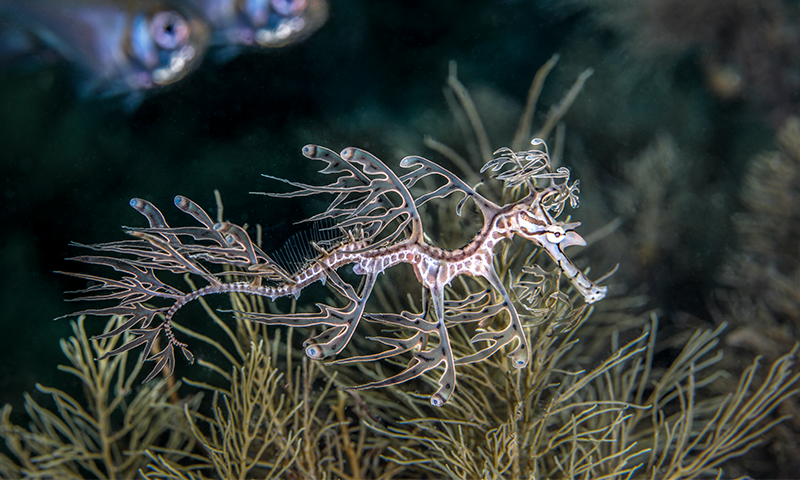
The leafy seadragon lives up to its name: Its long sinuous back and tail are graced by a mane of frilly fins that resemble the leafy seagrass meadows where it likes to hang out. Spotted in the cooler reefs off the coast of Raid Bay, South Australia, this baby seadragon floated past a lurking school of rough bullseye fish—and into the frame of Jenny Stock, a British underwater photographer, whose image was a Close Up Photographer of the Year prizewinner. The tiny seadragon's elongated body measures less than half an inch.
The bullseyes in the background may look as though they are enthralled with the passing seadragon, but it’s unlikely they viewed it as prey. Seadragons have few natural predators, in large part because their flamboyant appendages actually provide a highly effective form of camouflage.
Seadragons can adjust the color of their leafy limbs to match their surroundings, and they often use their tails to grasp onto nearby kelp and seaweed, mimicking the appearance of leaves swaying in the water current. And though they’re extremely slow swimmers who rarely venture outside a limited home range, seadragons have many methods of self-protection. Beyond camouflage, they also sport tough jointed plates and sharp dorsal spines that deter would-be predators.
Seadragons can adjust the color of their leafy limbs to match their surroundings.
Seadragons are endemic to Australia, but they face ongoing habitat and population threats from human development, overfishing, and ocean warming, among other things. Part of the difficulty in conserving these fish is that their expert camouflage actually makes it hard for scientists to locate and monitor populations.
Even so, a dedicated group of Australian scientists is working to reverse population loss, using a combination of machine learning and community science. While researchers have long relied on footage collected from dive surveys to locate and manually identify seadragon distribution, researchers at Seadragon Search recently developed algorithms to automate the process. These algorithms help to identify the unique appendages, markings, and patterns from thousands of crowd-sourced images, helping scientists better track the spread and development of these tiny floating monsters over time.