















 Facebook
 Twitter
 Pocket
 Reddit
 Email
Email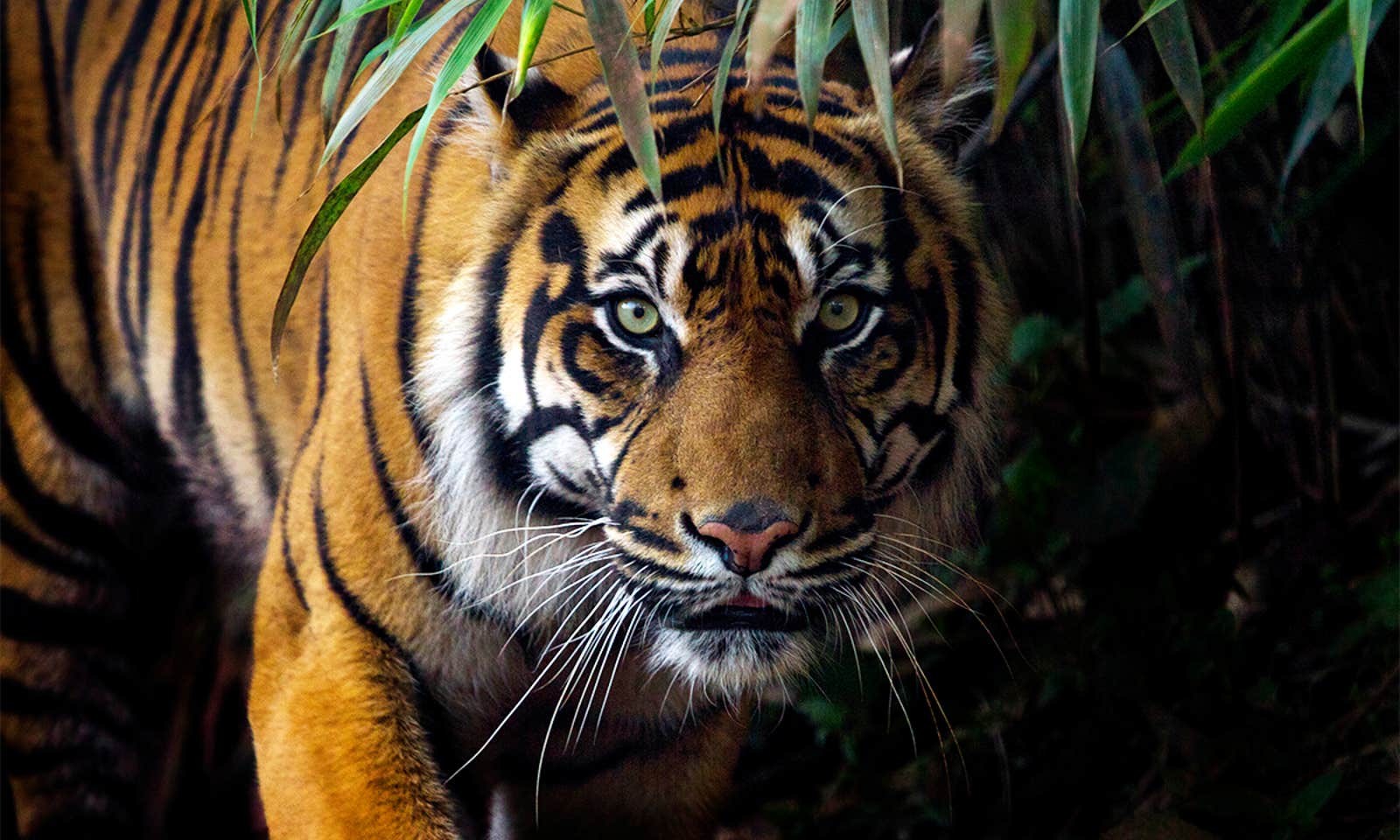


It’s nearly impossible to see a tiger (Panthera tigris) outside of a zoo. Between habitat loss, prey declines, and poaching, the species has been extirpated from more than 90 percent of their original range—for example they’re entirely gone from the forests of Vietnam, Cambodia, and Laos. Some tiger populations remain on the island of Sumatra, but assessing the status of this critically endangered subspecies of the big cat has been difficult, given its cryptic nature and scarcity.
Recently captured images from camera traps on Sumatra hint that populations there might be in relatively good shape.
In a paper published today in Frontiers in Conservation Science, a team of Indonesian conservation scientists reports a success story in evaluating a population of Sumatran tigers (subspecies P. tiger sumatrae) in the Leuser Ecosystem, the largest remaining contiguous tiger habitat in Sumatra. In a previous study of tiger density in Gunung Leuser National Park, nestled in the heart of the ecosystem, using infrared camera traps, only five individual tigers were spotted, precluding reliable density estimation.
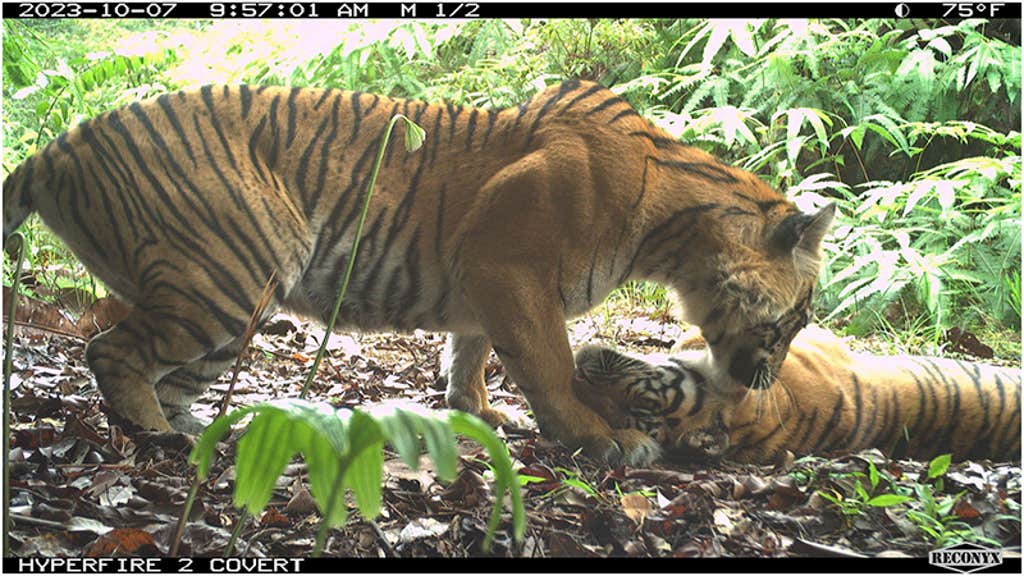
For this study, the scientists hoped to increase the sample size of observations by using more cameras over longer stretches of time.
During three monitoring periods spanning about 18 months, 34 pairs of infrared cameras were deployed for intervals of 90 and 180 days in protected forest areas outside of the national park. Each camera pair photographed the same spot from different angles, which made it easier to identify an individual tiger passing through. The cameras yielded 282 images that were clear enough to identify 27 individual adult Sumatran tigers. In addition, three sets of cubs were recorded over a 6-month period.
“Multi-year camera trap monitoring is critically important for estimating key tiger demographic parameters such as survival, recruitment, tenure, and population growth rate,” explained study co-author Joe Figel, with Indonesian conservation organization Hutan Harimau, in a statement.
Read more: “The Groundhog Watchers”
By extrapolating population size based on how many times the same individual was sighted, the researchers came up with densities of 1.42–2.35 tigers per 38.6 square miles. That’s more than double the densities reported from earlier studies inside the nearby Gunung Leuser National Park.
“Leuser has maintained important patches of lowland and hill forests where, in Sumatra, tiger prey densities reach their highest levels,” added Figel.
The results suggest that some of the best Sumatran tiger habitats lie outside Gunung Leuser National Park, in forested areas protected by the provincial government that oversees Aceh, the westernmost province of Indonesia. The study also highlights the importance of deploying lots of camera traps over extended periods of time to generate more-accurate population estimates for secretive species, particularly apex predators with large home ranges. 
Enjoying Nautilus? Subscribe to our free newsletter.
Lead image: tom177 / Shutterstock