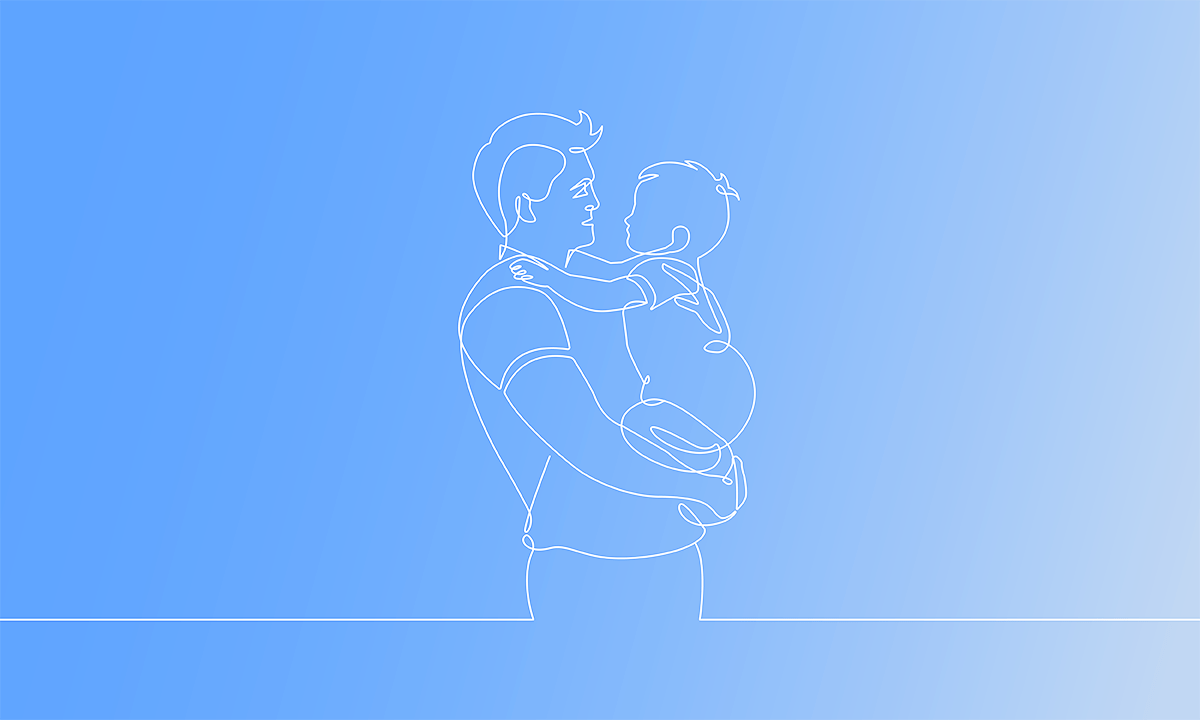
In the history of human parenting, childcare has often been treated as maternal by default, paternal by exception. When mothers do it, it’s duty. When fathers do it, it’s help. A father’s love has been tallied as optional in the child’s development.
But decades of research have begun to redraw this map: Scientists are finding that consistent paternal care can help to shape everything from language development and social competence to academic persistence and mental health. And the benefits of dad’s involvement aren’t interchangeable with the ones kids get from mom.
And now, a new study shows a father’s early emotional engagement with his infant may stabilize the whole family system in ways that quietly protect a child’s long-term physical health. The scientists, from Penn State College of Health and Human Development, published their findings in Health Psychology.
Fathers who were emotionally tuned into their babies before their first birthday were more likely to have cooperative, low-conflict relationships with the child’s mother a year later, the researchers found. And in those families, the kids were physically healthier years down the line, at age 7, in ways that showed up in their bloodwork.
The big surprise: Neither the mother’s warmth when the child was an infant, nor her ability to co-parent harmoniously when the child was 2 years old, had much bearing on the kids’ physical health at the age of 7.
Read more: “My Visit with My Dead Father’s Brain”
“Everyone in the family matters a lot,” said Alp Aytuglu, postdoctoral scholar in Penn State’s Department of Biobehavioral Health, in a statement. “Mothers are often the primary caregivers, and children are experiencing the most growth and development. The takeaway here is that in families with a father in the household, dads affect the environment in ways that can support—or undermine—the health of the child for years to come.”
To conduct their study, the researchers examined videos and other information from the Penn State Family Foundations project, funded by the National Institutes of Health, which covered 399 families in the United States that included a mother, father, and first child. Some 83 percent of these families identified as non-Hispanic white and had higher than average levels of income and education.
The original Family Foundations researchers visited each kid in the study when they were 10 and 24 months old, recording 18-minute videos of the parents playing with the child. Trained evaluators later reviewed the video. They assigned codes to specific parenting behaviors, including response time, warmth, and age-appropriateness of their interactions. They also assessed co-parenting behaviors, such as competing for the child’s attention versus taking turns naturally. They noticed that when one parent competitively gained the kids’ attention, the other tended to disengage.
When the child turned 7, the researchers collected a blood sample that they then analyzed in the lab, measuring four markers of heart and metabolic health: cholesterol, blood sugar regulation, and markers of liver and immune system inflammation. They then ran their data through a statistical modeling approach known as structural equation modeling.
They found that fathers who were less attentive to their children at 10 months old were more likely to have trouble co-parenting later. They tended to either compete for their children’s attention or withdraw from play when the kid was 2. This kind of parenting behavior was linked to higher levels of glycated hemoglobin, which helps to regulate blood sugar and c-reactive protein, a marker of inflammation in the liver that tends to rise rapidly in response to infection, injury, or inflammation.
“No one will be surprised to learn that treating your children appropriately and with warmth is good for them,” said Hanna Schreier, professor of biobehavioral health at Penn State and an author of this study. “But it might surprise people that a father’s behavior before a baby is old enough to form permanent memories can affect that child’s health when they are in second grade. It is generally understood that family dynamics affect development and mental health, but those dynamics affect physical health as well and play out over years.”
The researchers were surprised by the finding about mothers’ care and kids’ health. They thought the influences would be on par for mothers and fathers.
“In two-parent families like the ones in this study—the mother is frequently the primary caregiver,” explained Jennifer Graham-Engeland, a professor of biobehavioral health at Penn State and an author of the study. “So it is possible that whatever the mother’s behavior, it tends to represent the norm in the family, whereas the father’s role tends to be one that reinforces the norm or disrupts it. It is also likely that mothers affect children’s health in ways other than those specifically examined in this study.”
Mothers may know best, but fathers may sometimes be the ones calibrating the system. 
Enjoying Nautilus? Subscribe to our free newsletter.
Lead image: h3x / Shutterstock