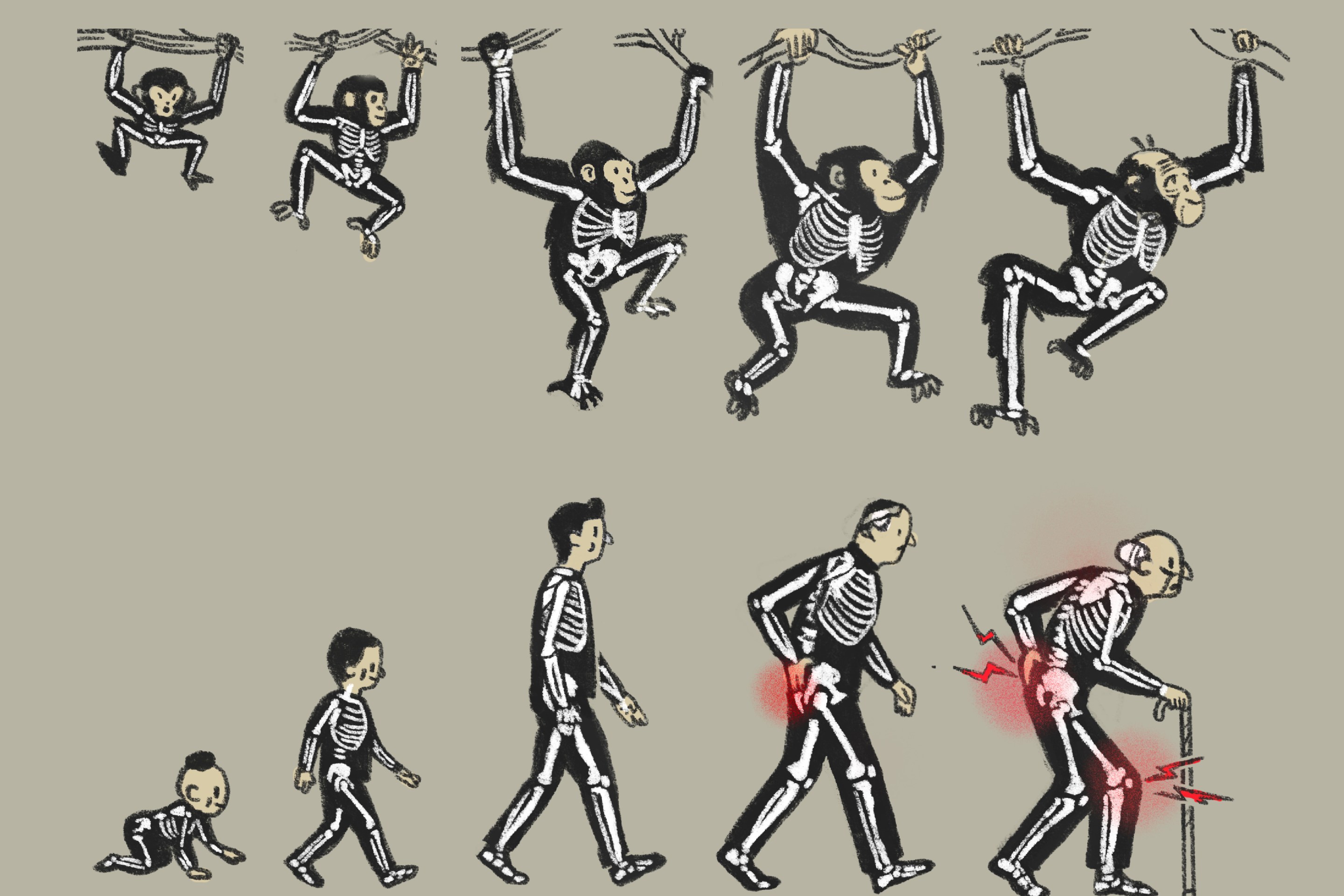
Whenever you take a stroll, you take advantage of a key feature that separates us from our ape relatives—bipedalism, or walking upright on two legs.
Fossils with signs of this trait can point scientists to our earliest human ancestor, or the first member of the hominin group that includes modern and extinct humans. A possible candidate for this ancient relative: Two decades ago, scientists announced the identification of Sahelanthropus tchadensis, a hominin species from around 7 million years ago—around the time when humans split from apes.
Back then, researchers had examined jaw bits, teeth, and most of a cranium from S. tchadensis, which were found in what’s now the country of Chad. More recent research has zeroed in on two pieces of forearm bones and part of a thigh bone or femur that were later identified as belonging to the same species.
Since S. tchadensis was unveiled, scientists have squabbled over the possibility that it was bipedal. Some have even questioned whether the creature was a hominin at all.
Now, analysis of limb bones from this species suggest that it could indeed walk on two legs. While the bones they observed look similar to those of chimpanzees, they found several compelling pieces of evidence of bipedalism, findings reported in Science Advances.
A team from across the United States took a close look at these bones and discovered a key indicator of bipedalism: a femoral tubercle, a bony bump on the femur where the iliofemoral ligament attaches; it’s the biggest and most powerful ligament in the human body, and links the femur to the pelvis. This feature has only been found in bipedal hominins, and it is a crucial ingredient for upright walking.
Read more: “How Posture Makes Us Human”
They also confirmed hominin-like details in the bones that were pinpointed in past studies: a twist in the femur that helps orient the legs forward, and muscles that keep the hips stable and assist in walking, standing, and running. Additionally, the femur was relatively long compared with the ulna, a bone in the forearm, another hint of bipedalism.
S. tchadensis did have shorter legs than modern humans, but its femur length wasn’t too far off from a sample taken from Australopithecus, a genus of early hominins that evolved around 4 million years ago.
Overall, the evidence suggests that “bipedalism evolved early in our lineage and from an ancestor that looked most similar to today’s chimpanzees and bonobos,” said study co-author Scott Williams, an evolutionary morphologist at New York University, in a statement.
This species “was essentially a bipedal ape that possessed a chimpanzee-sized brain,” Williams added. It seems to have spent much of its days in trees, seeking out food and safety, but was adapted to walk on the ground. S. tchadensis may offer an example of an “early form of habitual, but not obligate, bipedalism,” the authors noted in the paper, as they think bipedal behavior grew over the course of evolution before it became a more heavily utilized hominin characteristic.
Ultimately, the path toward traversing the world on two legs may have proven a marathon, not a sprint. 
Enjoying Nautilus? Subscribe to our free newsletter.
Lead image: Didier Descouens / Wikimedia Commons