















 Facebook
 Twitter
 Pocket
 Reddit
 Email
Email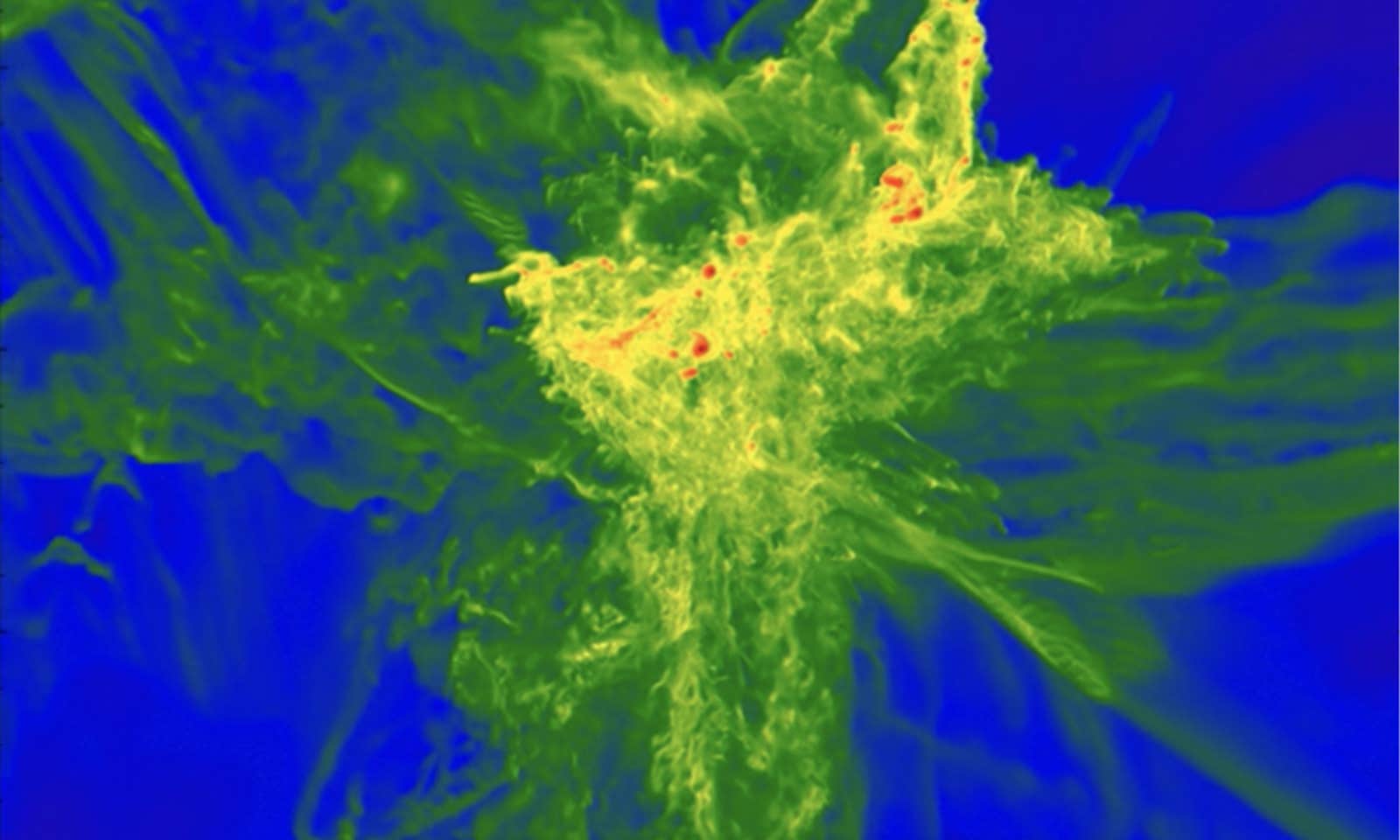


A star becoming a black hole happens in the same way as Ernest Hemingway described going bankrupt: “First it happens gradually, then all at once.” The gradual part of the process can take a lot longer than the time it takes to drain a bank account—billions of years in some cases. That’s why astronomers were puzzled when they found evidence that supermassive black holes existed less than a billion years after the Big Bang.
In order for the timeframe to make sense, the stars that collapsed to form these black holes would’ve had to have been gargantuan—1,000 to 10,000 more massive than our sun. Now, for the first time, scientists have found direct evidence that these monster stars roamed the cosmos during the dawn of the universe. They published their findings in the Astrophysical Journal Letters.
“These cosmic giants would have burned brilliantly for a brief time before collapsing into massive black holes, leaving behind the chemical signatures we can detect billions of years later,” co-author Daniel Whalen, a cosmologist at the University of Portsmouth in the United Kingdom, said in a statement. “A bit like dinosaurs on Earth—they were enormous and primitive.”
Read more: “The Black Sheep of Black Holes”
Whalen and his colleagues used the James Webb Space Telescope to study GS 3073, a galaxy with a black hole at its center, 12 billion light-years away from Earth. Examining the chemical signature of GS 3073 showed an intriguingly high ratio of nitrogen to oxygen, an elemental fingerprint the team says is characteristic of a monster star.
“Our latest discovery helps solve a 20-year cosmic mystery,” Whalen said. “With GS 3073, we have the first observational evidence that these monster stars existed.”
Using computer simulations, the team recreated the evolution of these supermassive stars into supermassive black holes. According to their model, the stars first burn helium in their cores, which produces carbon. Then, the carbon leaks into the star’s surrounding shell, where hydrogen is burning. Next, the carbon combines with hydrogen to produce nitrogen, which is carried by convection currents throughout the star. Finally, this nitrogen-rich material escapes into space.
The models also show what happens when the star becomes a black hole. Instead of exploding, these stellar monsters skip going supernova and collapse directly into a supermassive black hole (the “all at once” phase).
These recent findings offer a fascinating glimpse into a period of time astronomers refer to as the “Cosmic Dark Ages,” when the furnaces of newly born stars first forged the elements that make up the rest of our universe—us and our Earth included. 
Enjoying Nautilus? Subscribe to our free newsletter.
Lead image: Nandal et al