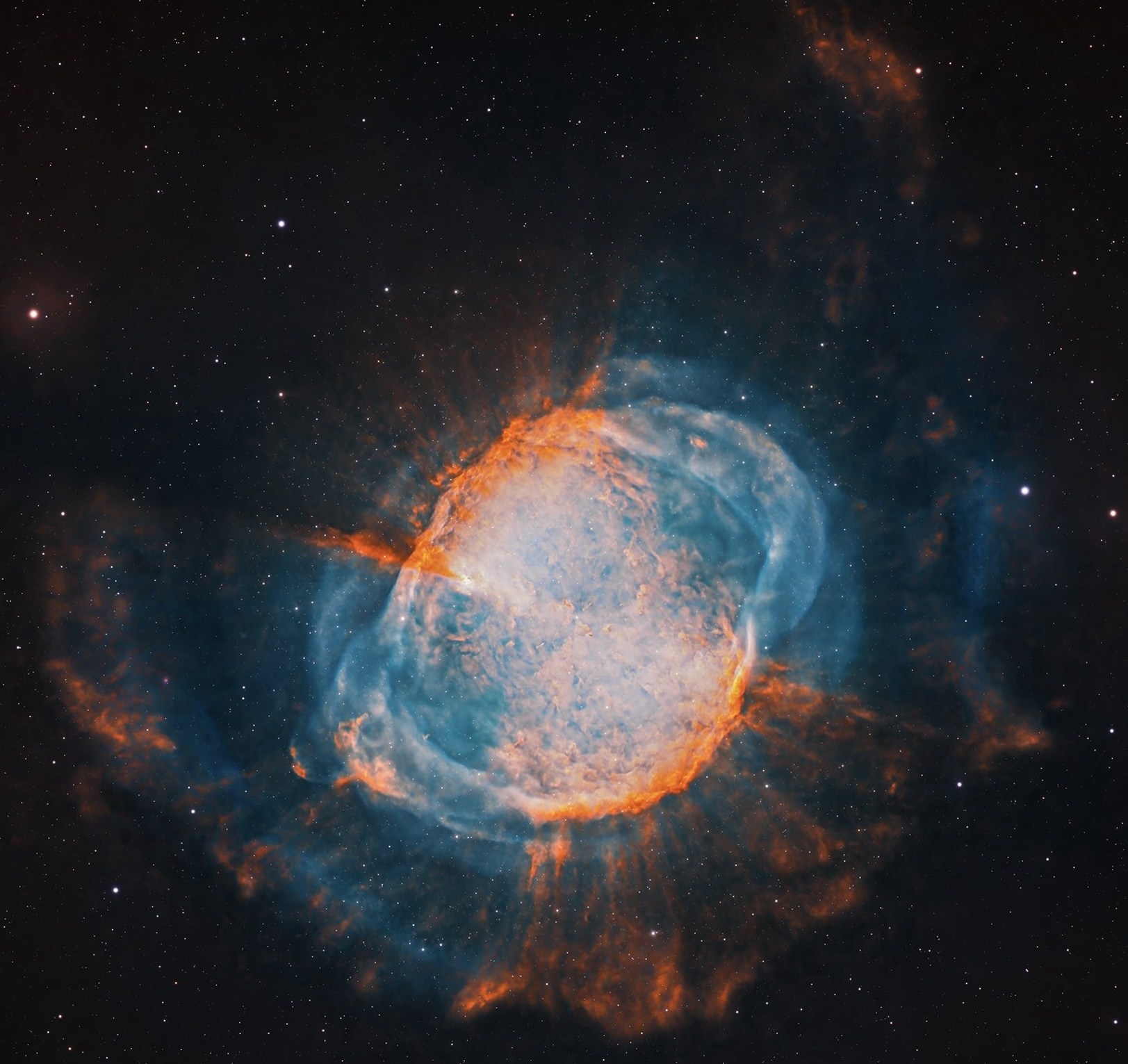
The Hubble Space Telescope is still orbiting Earth, snapping stunning photos of celestial phenomena close to home. One of the latest captures the Egg Nebula, a young nebula surrounding a dying star located in the constellation Cygnus, the swan 1,000 light-years away.
The image shows twin beams of light shining from the star, hidden in a thick disc of stardust, illuminating the gases of the nebula like Klieg lights through fog. The starlight is reflected by the gases, radiating one-tenth of a light-year outward in concentric circles.
The Egg Nebula attracts the attention of astronomers because it’s in a pre-planetary transition stage that lasts only a few thousand years—the blink of a cosmic eye. As such, it offers an invaluable window into the period before stars exhaust their fuel and shed their outer layers, creating brilliant clouds of illuminated gas.
Read more: “Inside an Exploded Star”
Hubble has captured images of this stunning formation before (the first in 1997), and astronomers will compare these recent images to older ones, exploring how the star has evolved over the past few decades.
At age 35—three decades older than its younger brother, the James Webb Space Telescope—the Hubble is getting a little long in the tooth, but in cases like these, age is an asset. 
Enjoying Nautilus? Subscribe to our free newsletter.
Lead image: ESA/Hubble & NASA, B. Balick (University of Washington)