ADVERTISEMENT
Nautilus Members enjoy an ad-free experience. or Join now .

Unravel the biggest ideas in science today. Become a more curious you.

Unravel the biggest ideas in science today. Become a more curious you.

The full Nautilus archive eBooks & Special Editions Ad-free reading

  • The full Nautilus archive
  • eBooks & Special Editions
  • Ad-free reading
Join
Explore

To understand our strange future, we have to remember that we are a dying species, as are all species on the Earth. But this condition is not just because of the inevitable geophysical and astrophysical changes that will modify and even erase the Earth’s present environments. Our species, like any other, hovers in only a temporary—largely illusory—equilibrium before evolution whisks things along in a churn of divergence, speciation, and extinction. All of this has happened before, and all of this will happen again.

Nautilus Members enjoy an ad-free experience. Log in or Join now .

Early hominins, who provided an opportunity for Homo sapiens to emerge into a distinct form, had their own extensive history across hundreds of thousands of years before dissolving away. Some left their genetic echoes in us all, others perhaps not. For most lifeforms there is a Faustian bargain of sorts. Innovative and complex forms can have their days in the sun before succumbing to evolutionary pressures and being subsumed into or replaced by new glittering creatures. But sometimes an innovation comes along that further modifies the rules of the game itself.

On the face of it, space exploration is such an unequivocally ridiculous trait that for a species to acquire is absurd. Life that has found profound success for 4 billion years by integrating with—and modifying—the systems of a single, wet, rocky planet is now pushing its boundaries into what seems like unspeakably inhospitable terrain. That move is fraught with problems, whether from the constraints of physical laws or the incompatibility of terrestrial ways of living with the energetic needs and damaging forces of the local cosmos.

ADVERTISEMENT
Nautilus Members enjoy an ad-free experience. Log in or Join now .

Our species, like any other, hovers in only a temporary—largely illusory—equilibrium.

To make any of it work, extraordinary demands are placed on life’s extended augmentations, in the form of robotic systems and engineered materials, as well as the neural systems of human designers and scientists. Missions are assembled that contain millions of physical parts, elaborately synthesized from Earth’s elements that are both abundant and rare. Altogether, these parts can have thousands of functions and are built to extraordinary standards of redundancy and flexibility which anticipate events that may or may not ever be encountered. This is almost antithetical to biological evolution’s frequently thrifty, no-frills efficiency.

Even more absurdly, space exploration has its roots in the non-material, from the symbolic abstractions that people like Isaac Newton and Pierre-Simon Laplace invented to describe the motions and properties of the world. The moment that they formulated mathematical expressions to calculate an orbital path, they took the first steps toward being interplanetary. When Émilie du Châtelet, Mary Somerville, and Emmy Noether crafted their insightful interpretations and far-reaching theorems, they sped up this evolution of the possibilities of evolution, turbocharging it with ideas and clues. Darwin, with his nose deep in Earth’s pungent biosphere, also changed how we think about the world and our path from present to future. He made the present more significant and the future far more open-ended and interesting.

ADVERTISEMENT
Nautilus Members enjoy an ad-free experience. Log in or Join now .

As our species has explored these ideas, we’ve simultaneously extended life’s tendrils across the solar system and turned the Earth into an enormously scrutinized and digitized world. In doing so, we’ve learned that there are no other planetary environments that match what exists on the Earth. The moon and Mars are fascinating and important way stations, but they are also extraordinarily challenging places for life like us to exist, with their weak gravity and exposed environments. Venus and Mercury present brutal conditions for terrestrial life and materials, except perhaps for the racing Venusian cloud tops, whereas somewhere like distant Titan is so alien that it remains a place solely for machines. There may also be chemically rich, dark oceans inside icy moons and dwarf planets in the outer solar system, but for now they’re barely accessible to us.

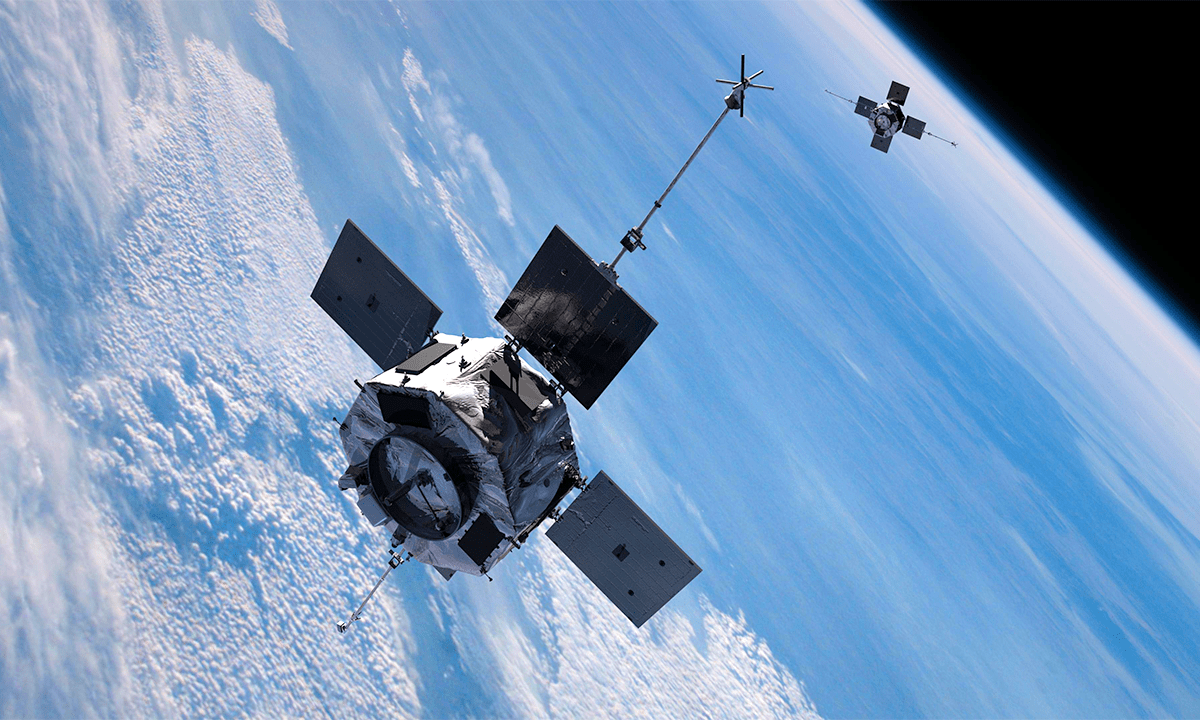
Yet life is busy making its transition to being interplanetary right now. It’s very clear that for the past century we’ve been creating a substantial presence outside of the Earth. We are heading outward, learning as we go, and dragging the rest of Earth’s living systems along with us. Through tens of thousands of rocket launches and clever, complicated machines, the evolutionary path of life on Earth has reached an inflection point and a new trajectory. One possible if not probable form of this trajectory is Dispersal, the true nature of which finally comes into view: a synthesis of space exploration’s history, the architecture of the solar system, and the malleable nature of evolution itself, all projected into the future.

New openings for biological evolution will take our species on thousands of new paths.

ADVERTISEMENT
Nautilus Members enjoy an ad-free experience. Log in or Join now .

Once again, there are lessons from past experiences. When Darwin sailed on the Beagle, from 1831 to 1836, he had an opportunity to see a planet on the cusp of unimaginable change. In the 1830s the total human population was just 1 billion, the cumulative energy use by the technosphere was 25 times less than it is today, and oil and natural gas hadn’t yet become global resources or catalysts of conflict. The estimated extinction rate of species in the 1830s was 10 times less than it is now. Global atmospheric CO2 concentrations sat at around 284 parts per million, barely changed from 100 years earlier, and far lower than today’s 422 parts per million. Atmospheric concentrations of the potent greenhouse gas methane were around 780 parts per billion, compared to today’s levels of over 1,850 parts per billion—a figure made even more significant because methane has an atmospheric lifetime of just 12 years and persists only because there are human actions that cause it to be constantly released into the atmosphere. Although there were plenty of wars and geopolitical tensions in the 1830s, and across different continents many awful practices of slavery and subjugation continued unabated, truly global conflicts and weapons technology capable of fully rewriting the history of life on Earth were yet to come.

The magnitude of those subsequent changes is reflected in something that the cosmonaut Yuri Gagarin said more than a century later. One of his reflections on being the first human to make a single complete orbit of the Earth, in April 1961, was that “looking at the Earth from afar you realize it is too small for conflict and just big enough for co-operation.” This astute and heartfelt observation was made in a radically different world than Darwin’s. By the 1960s, Earth was filled with interconnected humans pushing up against one another and was a place where nations could now unleash the fury of thermonuclear bombs to wipe all civilizations off the planet.

But if we project a little way into the future, Dispersal could actually turn the human clock back in more positive ways. We know that physical scales and temporal separations profoundly affect complex systems, as they have done for organisms scattered across places like the Galapagos. If our species and other species become spread across the solar system in a Dispersal, we will all begin to disconnect in ways that are far more profound than what happens across Earth’s great oceans and continents. Dilute us enough, and there are parallels not just with the conditions of the 1830s but also with a time a 100,000 years or more ago, when generation upon generation of hominins could exist without ever feeling the direct influence of other groups.

ADVERTISEMENT
Nautilus Members enjoy an ad-free experience. Log in or Join now .

Of course, it can’t be quite the same, not least because of the webs of communications and transport that have to exist to keep interplanetary existence running. But this very same technological connectivity also creates an opportunity—if taken—to break away from the cycles of economics and inequalities that are so entrenched on the Earth. Further down this timeline there could be new forms of independence for humans and eventually new openings for biological evolution to take our species on thousands of new paths, especially if we tinker with biology directly, through gene editing to tweak our physiological baselines, driven by a desire to be more resilient to alien environments. All of this could make our descendants’ future and the future of all life in the solar system far more robust against any kind of existential crisis. Dilution and diversity may be the ultimate strengths in a Darwinian universe.

If this all sounds too good to be true, well, of course, it might be. The path to all futures will inevitably have glitches and terrible traps. But Dispersal is a possibility, another kind of boundary condition in a complicated landscape of decisions and turning points. As with space exploration today, those possibilities will depend on ideas and on how science and technology evolve alongside us, and evolve they will.

Read Caleb Sharf’s “3 Greatest Revelations” while writing The Giant Leap here.

ADVERTISEMENT
Nautilus Members enjoy an ad-free experience. Log in or Join now .

Excerpted from The Giant Leap: Why Space is the Next Frontier in the Evolution of Life by Caleb Scharf, copyright ©2025 by Caleb Scharf. Used with permission of Basic Books, a division of Hachette Book Group, Inc.

Lead image: Teo Tarras / Shutterstock

Fuel your wonder. Feed your curiosity. Expand your mind.

Access the entire Nautilus archive,
ad-free on any device.
1/2
FREE ARTICLES THIS MONTH
Become a Nautilus member for unlimited, ad-free access.
Subscribe now
2/2
FREE ARTICLES THIS MONTH
This is your last free article. Get full access, without ads.
Subscribe now